
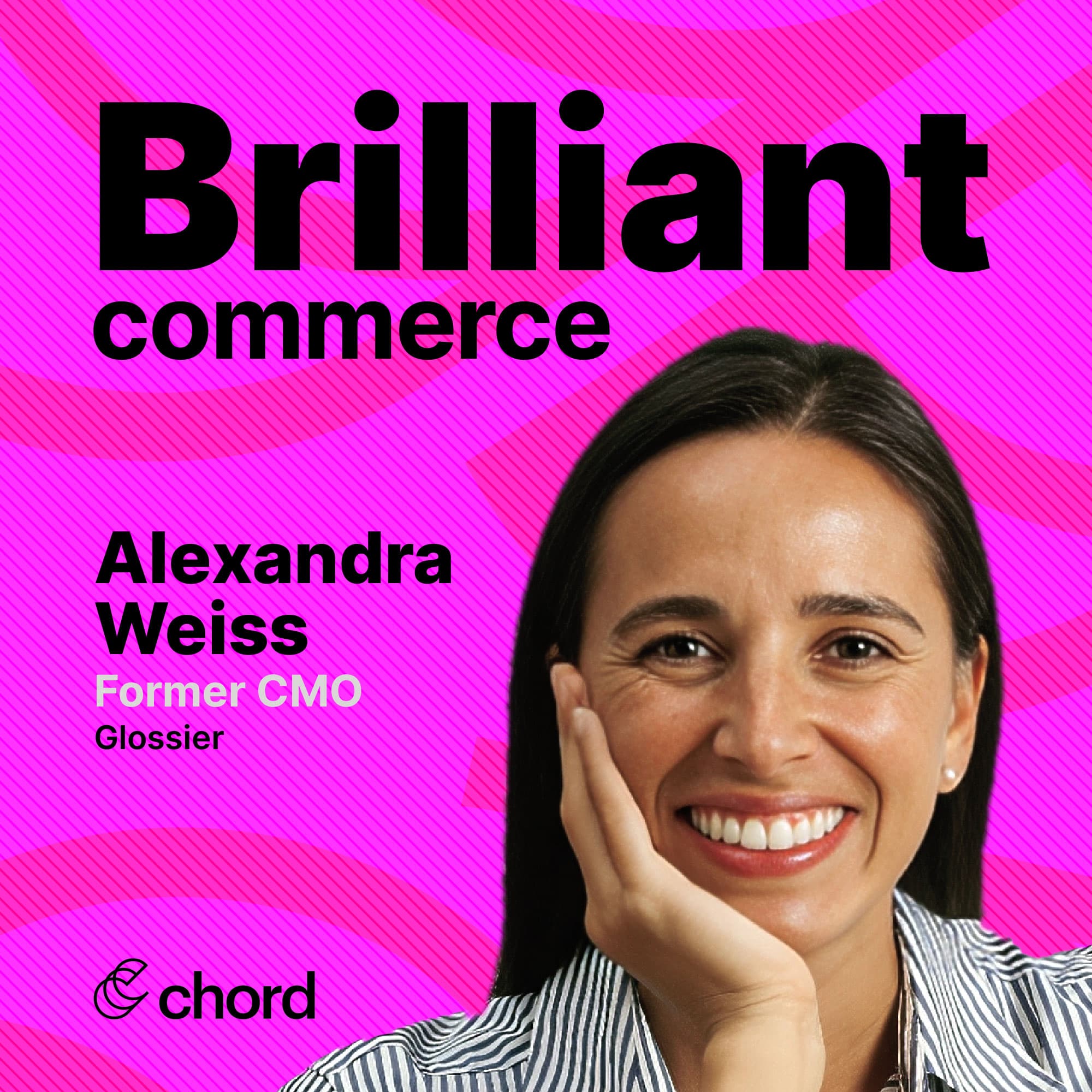
Ali Weiss spent a decade building the Glossier playbook from the inside, and joins Bryan to unpack what actually scales and what doesn't. They cover early social marketing, balancing performance with brand-building, why she thinks in terms of "data-informed" rather than "data-driven," and where AI fits into modern marketing without replacing human judgment.
Behind the Expert
Ali Weiss joined Glossier in its earliest days by her own account "not a marketer" — her background was finance and corporate strategy, plus, as a former competitive ballet dancer, an instinct for creativity that she paired with analytical rigor. She'd interned at Harry's during business school and was drawn to the first wave of direct-to-consumer brands using storytelling and social media to build direct relationships with customers rather than routing everything through a distributor or a big-box shelf. Over roughly a decade at Glossier — working alongside Chord co-founder and CEO Bryan Mahoney, who partnered with the brand from the supplier side starting in 2014 — she rose to Chief Marketing Officer, helping take the company from a small team hacking together spreadsheets for customer data to a scaled beauty brand with a centralized data warehouse, a distinct brand voice, and campaigns spanning full-spread New York Times ads to a Black Friday promotion so effective it nearly outran its own load testing. She has since moved into board and advisory work as a founder and entrepreneur in her own right. Her throughline across all of it: data is fuel for conviction, not a replacement for judgment.
The Quick Hits
- Weiss joined Glossier without a traditional marketing background and argues that was the advantage, not the liability: without an inherited playbook, the team had no choice but to build one from the customer up, staying "deeply devoted to the customer experience" regardless of function or title.
- Glossier gave customers a real seat at the table — shaping stories, campaigns, and even some products — but stopped short of full crowdsourcing. The team stayed the final editorial authority, keeping a consistent point of view even as it let customer voices define the brand's texture.
- Her filter for data is simple: "data for data's sake is not helpful. You need data for action's sake." The goal was always a layered, 360-degree picture of the customer — behavior, identity, and perception — built to drive a decision, not to sit in a dashboard.
- As a brand scales, qualitative signal increasingly converts into quantitative signal — an anecdote about why one customer loves you becomes a measurable pattern across many. Weiss puts Glossier's mature mix around 70-75% quantitative to 25-30% qualitative, while insisting the ratio isn't fixed and shifts with what the moment demands.
- On promotions, she warns against judging Black Friday by top-line revenue: one-time discount shoppers are, in her experience, the worst-performing cohort long-term, with no repeat behavior to show for the acquisition spend. She'd rather build conviction around customers who experience the brand as more than a deal.
- She reads the industry's swing back toward brand marketing — citing a Business of Fashion/McKinsey finding that 72% of surveyed brands planned to increase brand-marketing spend in 2025 — as a correction, not a retreat: performance-marketing "hacks" became table stakes and commoditized, leaving storytelling as the actual differentiator.
- On AI, her answer is "not yet" to it rewriting the playbook. It compresses the manual work — copywriting, iteration, data analysis — but she believes the final creative and strategic leap still needs a human, and she and Mahoney both land on "data-informed" over "data-driven" as the operating philosophy.
Joining Glossier "not a marketer"
Weiss and Mahoney met in early 2015 at the very first Camp Glossier, and Mahoney admits he went in having done some LinkedIn sleuthing on the team he'd be building the company with — and found a marketing leader who read as confident and inspiring despite, in his words, "a relative lack of traditional marketing expertise." Asked directly about that gap for the first time in a decade, Weiss doesn't dispute the premise. What she brought instead was a lifelong fascination with how brands build relationships with people, paired with an analytical background from finance and corporate strategy and, as a former ballet dancer, an instinct for creativity.
The advantage of showing up without a playbook
Mahoney frames the traditional alternative — a big brand hiring consultants and outside researchers to understand customers — as the playbook Glossier's team never had. Weiss agrees that not having one was itself an asset: it forced the team, regardless of function, into a shared devotion to the customer experience that, from the inside, felt obvious rather than novel.
Customer-centricity is easier said than done
Mahoney calls "customer at the center" the obvious pillar of the Glossier playbook — the kind of principle that should be table stakes for any brand today. Weiss pushes back on the word "obvious," arguing the phrase is easy to say and genuinely hard to operationalize, because business goals and internal agendas constantly compete with it for attention, and the customer underneath it keeps changing.
A seat at the table, not the whole menu
Mahoney points to a specific kind of risk Glossier took: letting customers help shape brand storytelling and even products, without handing over full control of what got made. He contrasts this with brands that tried literal crowdsourcing — "what product should we make next?" — and, in his view, got the equation wrong. Weiss's read is that Glossier customers were, in effect, co-creating the playbook by supplying raw, authentic material the brand then curated, rather than dictating the roadmap directly — and she draws the comparison to Nike, where the brand is defined by an entire ecosystem of people rather than one archetype.
The Black Friday that nearly took down the site
Mahoney's favorite Black Friday story from their years together: Glossier's marketing team sent a calendar invite for 12:01am Eastern to customers, flagging the once-a-year sale. Watching from what he calls the command center, he saw carts fill but conversions stall — then, at 12:01, a "tsunami of data" hit the servers as every reminder fired at once and the promotion auto-applied at checkout. No amount of load testing had covered that scenario, but the site held. Weiss remembers it as one moment in a longer arc — from a small, naive team just trying to participate in Black Friday for the first time, to an operation polished enough to plan cross-functionally for nearly any scenario.
Why Black Friday-only shoppers are the worst cohort
Weiss's practical playbook for holiday promotion starts with a brand's general approach to discounting — how a Black Friday offer relates to every other promotion run through the year, whether it's the best deal available at any time, and what the unit economics can actually support. But her sharpest point is about measurement: pushing sales into a shorter window rarely creates proportional incremental revenue, and the customers acquired purely on a once-a-year discount tend to be the least valuable long-term.
Brand marketing's comeback, and why "hacking" got commoditized
Mahoney cites a Business of Fashion/McKinsey finding that 72% of surveyed brands planned to spend more on brand marketing in 2025 than in prior years, and asks whether the number surprises Weiss. It doesn't — she frames the industry's earlier obsession with performance marketing as a product of its measurability, addictive in its day-to-day feedback loop, but ultimately a set of tactics that got copied into irrelevance.
Data for action's sake — a three-layer measurement stack
Asked whether NPS is a sufficient way to measure customer experience, Weiss says it's simple but not enough on its own — too much depends on how and to whom the question is asked. Her alternative is a three-layer stack: raw purchasing behavior at the base, who those customers are one layer up, and brand perception and awareness — measured quarterly — at the top. The whole thing, she says, still runs on the same discipline she applied to data generally at Glossier: it exists to be acted on, not admired.
AI, human judgment, and "data-informed" over "data-driven"
Asked whether AI rewrites the marketing playbook, Weiss's answer is "not yet." She sees real efficiency gains in copywriting, iteration, and data analysis, but holds that a human still has to make the final call on what ships. Mahoney connects this to an old debate the two of them used to have at Glossier — whether to aim for "data-driven" or "data-informed" — and argues that AI's rise makes the distinction more relevant, not less; being fully data-driven, in his view, risks a sterility at odds with a brand people are supposed to be friends with. Weiss lands firmly on the same side.
Sound Bites
- “I always joke that I came to Glossier not a marketer, and I almost left not a marketer. What I did bring to Glossier was two things. One, a deep passion for the way brands create relationships with consumers — even as a kid I used to make my mom stay in the cereal aisle at the grocery store for an ungodly amount of time, because I was so interested in understanding everything those brands were communicating on every side of the box.”
- “It's very easy to say, yeah, yeah, we're creating a brand or we're creating an experience with the customer at the center. But there are so many things that can easily distract from that — even things as specific as business goals or what's next on the team's agenda. Operationalizing that customer centricity — the effort is oftentimes underestimated.”
- “I always say I think the best brands are ones that are reflections of the entire community and ecosystem that make up that brand. Nike. And everyone is an athlete. But it's like all these different ecosystems of definitions of athletes are truly what define the brand — it's not just one singular person, one singular thing. What I'll add is that there still needs to be an editorial and curated point of view that makes the brand consistent.”
- “Black Friday shoppers — the ones who are buying just that one time a year — are, to my recollection, the worst-performing cohorts. Because if they're only buying from you that one time a year, at a discount, you're not seeing any repeat behavior over the year. I think the better approach is having conviction — however you're acquiring customers over that holiday period, full stop — that they'll be valuable customers.”
- “For a while, brands were really, quote-unquote, hacking performance marketing. A lot of that has become table stakes and commoditized to some extent. So the way brands are going to break through that noise is the brand marketing they bring into the mix.”
- “Data for data's sake is not helpful. You need data for action's sake, and for implementation's sake, in a way that actually drives results. There are three layers that are really important: understanding customer behavior, understanding who those people are, and understanding brand perception and awareness. I'd say the side dish to that three-course meal, for me, is just true anecdotes — we kicked off almost every marketing meeting for multiple years with a customer anecdote.”
- “I'd say not yet — at least not in the near future. But I fundamentally believe that a human still absolutely needs to be in the loop. I would definitely say we're on the same team on data-informed. I think data-driven has very strong implications of somewhat blindly applying data and letting it lead the way, versus using it as an element toward your considerations.”
The Chord take
Weiss's account of building Glossier's marketing function keeps landing on the same structural choice, applied to three different problems: how much to let customers into the brand, how much to trust data over instinct, and now, how much to hand over to AI. In each case her answer is a bounded yes — customers get a seat at the table but not the whole roadmap; data drives decisions but only once it's been interpreted, not "for its own sake"; AI compresses the manual work but a human still executes the final leap of judgment. That's a harder discipline than either extreme, because it requires an organization to keep deciding, case by case, where the boundary sits rather than defaulting to a rule. Her Black Friday framing is the sharpest illustration of why this matters commercially, not just philosophically. The instinct to measure a promotion by the revenue it drives in a four-day window obscures the fact that the customers acquired that way are often, in her account, the worst long-term cohort a brand has — no repeat behavior, no relationship, just a discount captured once. The fix isn't to skip the promotion; it's to measure it against lifetime value and design the moment to build conviction in the customer rather than just clearing inventory at a lower price. The same logic runs through her position on AI and data: the tools that make it easiest to move fast — automation, dashboards, algorithmic bidding — are exactly the tools most likely to substitute apparent progress for real understanding of the customer, unless someone is deliberately holding the line on where judgment still belongs to a person.
Put it to work
- 1Before crediting a promotional period with success, separate the customers acquired on a one-time discount from the rest of the cohort and track their repeat-purchase rate. If they don't come back, question whether the acquisition spend was worth it, regardless of top-line revenue during the window.
- 2Build a lightweight ritual for qualitative signal — Weiss's team opened nearly every marketing meeting with a customer anecdote pulled from social, stores, or support — so dashboards don't crowd out how customers actually describe the brand in their own words.
- 3When inviting customers into brand-building — reviews, UGC, community input — draw the line explicitly: input into stories and positioning, yes; a vote on the product roadmap, generally no. Keep a consistent editorial point of view even as the raw material gets more democratic.
- 4Before adopting a new AI tool for a marketing workflow, name which step stays human. Treat AI's speed gains as license to iterate faster, not as permission to skip the final judgment call on what actually ships.
- 5As the customer base scales, expect the qualitative-to-quantitative mix to shift — what worked as a founder's anecdotal read on the brand needs to convert into a measurable layer once no one person can read all the feedback directly.
- 6Swap "data-driven" for "data-informed" in how your team talks about decisions. It's a small language change that keeps data as an input to conviction rather than a replacement for it.
Full transcriptShow ↓
This is Brilliant Commerce, brought to you by Chord. Here's your host, Bryan Mahoney, CEO and co-founder of Chord.
Bryan Mahoney
Welcome to episode two of the Brilliant Commerce podcast, where I sit down with the incredible people behind some of today's most iconic brands. We featured two of these brands, Sonos and Ruggable, on our first episode, and today I'm thrilled to be joined by Ali Weiss, formerly Chief Marketing Officer at Glossier, now turned board member, founder, and entrepreneur. Ali, thank you so much for being here.
Ali Weiss
Thanks, Bryan, for having me.
Bryan Mahoney
Let me first start by asking you — how were your holidays?
Ali Weiss
So far so good. We're in the throes of holiday season. Last week was good, but busy — spent a lot of time in the car and enjoyed a nice Thanksgiving dinner at my sister's house. And now I'm managing two sick kids.
Bryan Mahoney
Oh yes, the post-holiday cold.
Ali Weiss
Yes — holiday season and cold season.
Bryan Mahoney
Yeah, that's super fun. Did you take any time away from the Thanksgiving table to make any exciting Black Friday purchases — anything you're particularly proud of, or maybe embarrassed by?
Ali Weiss
I wish I had something more exciting to report back on, but most of my Black Friday purchases were pretty boring. Two fun things: every year I make photo calendar refills for both sets of grandparents — we got those from Artifact Uprising, so I took the opportunity to do that. And I'm a dental floss loyalist to the brand Cocoa Floss, so I bought a bunch of refills.
Bryan Mahoney
Oh my god, that's amazing — a bit utilitarian, but hey, completely fair. Maybe that's what Black Friday has become. I want to come back to Black Friday, actually, since we're just a few days past Cyber Monday. But first, let's take a trip down memory lane, if you'll indulge me. You and I met in early 2015, if I recall, at the very first Camp Glossier in Massachusetts.
Ali Weiss
I remember that. Hard to believe it was almost a decade ago.
Bryan Mahoney
Almost a decade ago, yeah. I've been thinking about this a bit ahead of today's conversation. I had some anxiety going into that weekend — I'd been working with the Glossier team on the supplier side since 2014, and I knew you'd recently joined along with a couple of other leaders. I'd done some LinkedIn sleuthing to see not just who I'd be camping with, but who I'd be spending the next several years building that company with. And what stuck out to me early on was that you came across as so confident and inspiring as a marketing leader — despite what my sleuthing told me was a relative lack of traditional marketing expertise. I never asked you about that then, so I'm going to take advantage of our time today to ask it now: can you tell me a bit about the path that led you to Glossier, and why you put your hand up to take that job?
Ali Weiss
I always joke that I came to Glossier not a marketer, and I almost left not a marketer — though I obviously learned a lot there and have done many things as a result since. Your read on my experience wasn't wrong. What I did bring to Glossier was two things. One, a deep passion for the way brands create relationships with consumers — I joke about this, but even as a kid I used to make my mom stay in the cereal aisle at the grocery store for an ungodly amount of time, because I was so interested in understanding everything those brands were communicating on every side of the box. That fascination with CPG and the way brands build relationships with customers over time has always been consistent in my interests. And prior to Glossier, I'd spent a bunch of time in finance and corporate strategy, so I had a bunch of analytical skills, and then, as a ballet dancer, some inherent creativity. So I had that mixture of left-brain, right-brain coming into it, and I really leveraged those natural instincts to create a new approach to marketing in the role. The reason I was excited to join Glossier is that it was at the beginning of the rise of D2C brands — I'd done an internship while I was still in business school at Harry's, the razor brand, and I was really interested in the way these brands were creating resonant experiences with consumers through a combination of amazing storytelling and a new approach to commerce online.
Bryan Mahoney
Yeah, if I remember correctly, that was brands like Glossier, Warby Parker, and Harry's emerging beyond what was traditional e-commerce — this category creation of direct-to-consumer, where storytelling was a huge component. That's why we had this direct connection with the customer — it was more than just getting them a product from a warehouse, better, faster, cheaper. It was really: how do we create these fantastic relationships with a customer, because we've got this very direct way of reaching out and having conversations with them.
Ali Weiss
Exactly. And I'd add — this was also at the very beginning of the rise of brands having a presence on social media. Social media was created for person-to-person interaction at first, and especially in the beauty space, some of the big brands were hesitant — should we even create an Instagram account? What we were able to do was leverage social media early on, not even from an advertising perspective, but from a storytelling and relationship-building perspective — to have a direct relationship with the consumer. So D2C wasn't only about e-commerce as a channel, to your point — it was about connectivity and direct conversation with individuals.
Ali Weiss
Before, bots were interfering, or people were sort of just having conversations for conversation's sake. We're having real, authentic conversations, and a deeper understanding of the consumer that you used to only be able to get by paying a third party to do research and talk to people directly.
Bryan Mahoney
Yeah. So that paying a third party — that was sort of the traditional playbook, I guess, a big brand that was hiring consultants and thinking strategically. I guess it leads me to ask: showing up on day one without a playbook, given the fact that you weren't a traditional marketer — do you think, if you reflect back, that was one of the elements key to your success, and allowed you to build what I think is one of the most successful playbooks ever in direct-to-consumer?
Ali Weiss
I think that not having a playbook — I think that's exactly right. I think not having a playbook was a really big advantage, and I sort of had that, and we as a team — everyone who was there, agnostic to the function or team you were on, were deeply devoted to the customer experience in a way that, when you're in it, didn't feel so unprecedented because it feels so obvious, but I think truly was unprecedented and special. And it was at the heart of how we created the playbook — keeping the customer and the consumer really at the heart and center of all of our execution, whether it was more qualitative, understanding their stories and what resonated with them, all the way to more quantitative things in understanding their behaviors with us.
Bryan Mahoney
Yeah, I mean it sounds so obvious that the customer's at the center, but that is kind of the pillar of that playbook, and seemingly a pillar that should now, with the arrival and cementing of direct-to-consumer and social media, forever need to be a pillar of any playbook going forward — at least in my opinion. Would you agree?
Ali Weiss
I completely agree. I think it's something I talk to people about a lot, because it's something that's so much easier said than done. It's very easy to say, yeah, yeah, we're creating a brand or we're creating an experience with the customer at the center. But there are so many things that can easily distract from that — even things as specific as business goals or what's next on the team's agenda. And that can distract you from truly listening to that customer, whose interests and behaviors are constantly evolving too. So it's like once you've cracked it once, it doesn't mean you've cracked it forever. You have to continue to listen, continue to analyze, continue to innovate in a way that puts them at the center. So operationalizing that customer centricity — the effort is oftentimes underestimated. The value is immense, though.
Bryan Mahoney
And I think it involves some degree of risk-taking too. As I think back on some of the risks that Glossier took — there was a willingness to let our customers in. There was a willingness to give them a seat at the table, and the ability to help shape not only the brand, but even some of the products. So striking that right balance between "we are the product experts and we know what's best" — and Emily certainly had a vision for what the market wanted — while also creating that room for the customer. I think that was one of the really interesting ways we put them at the center: giving them a seat at the table, but not going all the way toward crowdsourcing ideas. There were some brands I saw doing that in a way that was interesting — like, "what product should we make next?" But I forget what the brand was, and I think they didn't quite get the equation right. Whereas when I look back at some of those conversations, how bought-in our customers were to the products we were creating — where they were happy to take our lead, and certainly loved having their voices heard. How important do you think that was early on? And is it something you think the brand did a good job of over its ten-plus years of existence?
Ali Weiss
I think it was incredibly important. It's interesting — when you were just saying that, it made me think, and sort of say the sentence in my head, that I think the customers were creating the playbook with us in some ways. We let them in just enough that they were helping us figure out how to create content that resonated, tell truly authentic stories that felt real and relatable. And I think particularly in the beauty industry, so much of what had existed before was airbrushed and polished and not relatable — this untouchable, intangible, unachievable non-reality.
Ali Weiss
By seeing what customers wanted to share — the stories they wanted to tell, the pictures of their top shelves, the things they were sharing about their routines, the reality of what their desires were from a beauty-product perspective — by seeing that in a more raw and authentic way, they were able to do that with us. I always say I think the best brands are ones that are reflections of the entire community and ecosystem that make up that brand. There are some big brands where you can see the way they've captured and harnessed that so well — like, for example, Nike. And everyone is an athlete.
Ali Weiss
But it's like all these different ecosystems of definitions of athletes are truly what define the brand — it's not just one singular person, one singular thing. And I think that was really true of what we were building at Glossier, and continues to be true of the brand today. What I'll add is that there still needs to be an editorial and curated point of view that makes the brand consistent. Brands can be living and breathing things — but there was still a really clear vision of what the brand stood for, what its values were. We never let that waver.
Ali Weiss
And we were able to filter all those authentic stories through that lens, in a way that created consistency and reliability in what people wanted the brand to stand for.
Bryan Mahoney
Okay, so as promised, I want to shift gears away from the playbook and actually bring us back to Black Friday. As we record this, we're roughly forty-something hours after Black Friday, Cyber Monday, here on Wednesday morning, if my math is decent. This is your tenth Black Friday, Ali.
Ali Weiss
Yes, that's right.
Bryan Mahoney
Gosh, what a wild ride. I remember some absolutely insane ones. Before I keep peppering you with questions — I don't know if I've ever told you this story, but my favorite Black Friday with you was... I don't remember what year it was. Your marketing team had this really amazing idea for a promotion: we sent a calendar invitation for 12:01am Eastern time to all of our customers, inviting them, reminding them that we were about to go on sale, and that we'd only go on sale once a year. It was a really exciting moment.
Bryan Mahoney
I remember being at the command center, looking at all the data and statistics, looking at all these customers who were on the website adding things to their cart but wondering why I wasn't seeing anyone move from cart to checkout. I thought maybe something was wrong — I had that holy-shit moment, and I'd forgotten about the calendar invitation. Then I remember 12:01am hitting, and just watching what looked like this tsunami of data hit our servers, as everyone who'd built their carts in the moments leading up to 12:01 got their calendar reminder, had the promotion automatically applied to their order, and hit checkout.
Bryan Mahoney
No matter how much load testing we'd done, and all the preparations we'd put in place — that was the one scenario I hadn't prepared the technology team for. I just remember thinking, well, it's too late now, we just have to hold on. Luckily, the site held. But I remember thinking back on that moment, being in awe of the traffic we were able to drive over such a short period of time. Do you remember that Black Friday?
Ali Weiss
I'm sitting here — you obviously can't see me — with a big smile on my face as you're recounting that story. I do remember that moment very well. I feel like every Black Friday came with its own stresses, its own unique considerations. But it was pretty amazing to see, over time, how polished we were able to get from an operational perspective — knowing what that weekend was, and planning cross-functionally for every scenario.
Ali Weiss
I remember the first ones — almost being somewhat naive about it, like, "let's try this, there's this thing happening called Black Friday Cyber Monday, let's participate." We were still a small team and a small brand, and it was nice to dip our toes into it. Then it became months of planning leading into it, given the importance of what those three, four, five days ultimately represented — and it culminated in where we are today. You kicked off the podcast asking if I'd bought anything interesting over Black Friday, and this year, in particular, I bought nothing — I sort of sat on the sidelines.
Bryan Mahoney
To me, it felt like Black Friday as an industry kicked off in October, and it still seems to be going, and will probably keep going until retailers can't ship product from the warehouse in time to get it to your doorstep by December 25th. It's amazing, at least in my view, how things have changed over just ten years. Do you see it the same way? Is Black Friday, Cyber Monday as important today for a retailer as it was even a couple of years ago?
Ali Weiss
I think the holiday period generally continues to be incredibly important for the vast majority of retailers. There are some product categories, and some brands, that are less seasonal and don't rely on it as much. But I do think it's an important time. That said, the discrete four days between Black Friday and Cyber Monday — and five or six, if you count what bleeds into that — have become less important. As you said, it's bled all the way from October into December. I'll note I'm not actively working on an e-commerce business at the moment, but I think this was the shortest possible number of calendar days between Thanksgiving and Christmas this year, which is always a real challenge — that meant the pre- and post-holiday sale periods had to bleed into it even more.
Ali Weiss
Thinking about that, and just reminiscing about it over the holiday weekend, made me think about the continuing criticality of it. It's interesting, because if you remember, the construct of Black Friday and Cyber Monday came from a very discrete separation between brick-and-mortar shopping and e-commerce shopping. Black Friday, traditionally, even before Cyber Monday existed, was when people went to stores — lining up after their Thanksgiving dinners, waiting in line for deals at their retailer of choice.
Ali Weiss
Cyber Monday, in that period, was created as e-commerce was starting to boom — to capture those sales online, extend the sale period, and bring people who'd done their brick-and-mortar shopping on Friday back over the weekend and through Monday to capture those purchases online. It's interesting because now Black Friday is essentially omnichannel — as is Cyber Monday. It's this sort of retailer Super Bowl, we used to always call it the Super Bowl of sales and purchases. But at the end of the day, I think the actual day, or that four-day period, is beginning to fade, and there's more of a broad promotional period where the playbook is sort of the same across every brand.
Ali Weiss
We're going to do this on Friday and it's going to be different on Monday, and it's only going to be for those days — it's sort of just a broad period where people have to figure out their own unique marketing approach. It's going to work for their target audience, their target consumer, their product consideration cycle, and they execute on that. Which I actually think is even better, because instead of it all feeling the same and coming all at once, brands can do what works for them and their products. But it's very noisy and very crowded.
Bryan Mahoney
Yeah, noisy and crowded for sure. It's so funny — I'd completely forgotten about that. The invention of Cyber Monday was e-commerce's way of saying, well, we'd like a turn too. All those people lining up outside the store at eleven o'clock at night on Thursday, waiting to get in for the door-crashers on Friday. It's really interesting — it's been so all-consuming, especially now that it's so crowded and there are dollars, consumer dollars, available. I do think brands have done a good job of conditioning their customers that this is a good time to spend, so shopping happens.
Bryan Mahoney
It's increasingly difficult to stand out, or to do something different that hasn't been done before, in order to claim your share of those dollars.
Ali Weiss
Definitely.
Bryan Mahoney
Probably a hard question to answer, but I'm wondering — do you have any instant insights? If you were running marketing, what's your playbook for Black Friday over the next couple of years?
Ali Weiss
I think it would really orient on what I said before, which is: what is the brand's unique approach, or specific approach — it might not be unique — but a specific approach to promotion generally, and then how does Black Friday play into that? I actually remember it evolving — even in our time at Glossier, it was sort of like, this is our one time a year, and then we ended up running other promotions at other times of the year that made sense for the brand, the product, and the business goals. So I think the first thing I'd do is understand: what's our approach to promotion, and how does this play into it? Is it equivalent to other promotions we run throughout the year? Is it our best offer all year? How long do we want it to last?
Ali Weiss
What can we actually afford, from a unit-economics perspective, to give a customer a deal and remain competitive? I still think you have to play the game unless you're a no-promotion brand. But I'd also feel less constrained by the specific days and constructs of days — I think I'd probably feel drawn to start the promotion earlier. Actually, one of my biggest lessons over time has been that you typically see the same volume of sales spread out over a couple of days.
Ali Weiss
There might be some incrementality, but you need a good sense of: okay, if I run this over ten days, am I really going to see two times what I'd see over five days, or am I just going to see ten percent more than I'd see in five days — and is that worth it? And, by the way, to my recollection — and I'm not sure this is true of every brand — Black Friday shoppers, the ones who are buying just that one time a year, are the worst-performing cohorts. Because if they're only buying from you that one time a year, at a discount, you're not seeing any repeat behavior over the year. So what's the value in acquiring those customers anyway? I think the better approach is having conviction—
Ali Weiss
—however you're acquiring customers over that period, or over that holiday period, full stop — having conviction that they'll be valuable customers, and giving them an experience, a marketing approach, that helps them experience the brand in a way that shows they can be more than just a deal-seeker.
Bryan Mahoney
Yeah, that's really interesting. So, making sure we're measuring those cohorts, and looking back at them — it's not just about the top-line revenue we can drive over that period, because there are dollars being spent, but what's the long-term, or lifetime, value of those dollars? Is it better to sit on the sidelines, or be more conservative, and acquire a higher-quality customer through a different channel, at a different time?
Ali Weiss
Exactly.
Bryan Mahoney
It's interesting — I was with a brand yesterday, and I asked them about their Black Friday, because I'd heard anecdotally that it was mediocre across the board, across the industry — maybe better than I expected. But what they told me was that their Black Friday was actually quite good. One of the things they'd done to bring their customers along, and perhaps as a mechanism to make sure they were getting a good cohort, was running drops throughout the weekend, making products available. It wasn't just about the promotion — it was about products that were special, that weren't otherwise going to be available.
Bryan Mahoney
If you were an insider, if you were on the list, you had access to those drops, and there was a limited amount of product. I thought that was interesting — it feeds into this notion that it's a Super Bowl, it's an event, it's a spending frenzy. How do you get someone excited to be part of it, as opposed to just feeling like they're waiting for the deal to get five percent better before they buy the thing? I think strategically that's something I'd be looking at — how do we recruit people to be part of this event in a way that isn't just a race to the bottom on price?
Ali Weiss
I love that. I think it's a really unique approach, and I was reading a headline earlier this week that Black Friday and the entire holiday-weekend spending was up overall. I think one of the biggest challenges for newer, direct-to-consumer brands competing head-on in a really crowded space is how you capture some of that share. Unique strategies like that can really break through the noise and pull people back.
Bryan Mahoney
Yeah, I think so too. I think the other thing that helps you cut through the noise is evergreen marketing — let's maybe shift gears there for a second, because that's one of the other things that impressed me a ton about you and your leadership at Glossier: the focus on brand marketing in an era when everyone was really focused on hacking the system. Hacking wasn't Meta at the time — it was Facebook — and looking for that arbitrage, really just thinking about acquisition and letting go of brand marketing entirely. I came across a stat recently — a study co-sponsored by the Business of Fashion and McKinsey — that reported 72% of the brands they spoke with plan to spend more on brand marketing in 2025 than in previous years.
Bryan Mahoney
And I, for one, was really encouraged by that. Does that number surprise you, Ali?
Ali Weiss
It doesn't surprise me — I love hearing that. I think the industry went through a period where brands, agnostic to their stage, size, or channel, were honestly so obsessive about performance marketing, and it was twofold. One, it's measurable, right — you get those results on a day-to-day, week-to-week, even hour-to-hour basis. Being able to track those metrics is kind of addictive, in a way, and it helps you understand whether or not you're growing. But I think what's really important in the consumer space broadly is storytelling, and how compelling that can be in bringing people through their full consideration-to-purchase cycle — with awareness, all the way to consideration and purchase, with brands. So I'm not surprised. I'm actually quite excited to hear that.
Ali Weiss
I think one of the other dynamics driving that is that, for a while, brands were really, quote-unquote, hacking performance marketing. It seemed really early on — like, how can we hack the system, how can we get this cheap, how can we create really effective conversion flows, the best type of content? A lot of that has become table stakes and commoditized to some extent. So the way brands are going to break through that noise is the brand marketing they bring into the mix — to drive the awareness and consideration that ultimately does bring people to convert and to buy. I'm excited to hear that, and I think it'll keep things really interesting.
Ali Weiss
And I think it will help the brands that have the ability to tell their stories really effectively stand out and be successful.
Bryan Mahoney
Yeah, I was excited by it too. I think my hope here is that this is happening because there's been a realization that evergreen marketing, or brand marketing, is crucial to a brand's success — and I use the term "iconic brand" because I don't think you can ascend into that category without being great at brand marketing. The pessimist in me hopes it's not because brands have given up on performance marketing, or found it too hard or too expensive, and are just taking those dollars elsewhere. I really think the best brands out there are going to strike the right balance between brand marketing, customer experience, and performance marketing — because, taken together, the amplification that's possible can be really spectacular.
Ali Weiss
I completely agree. One thing I was getting at is this perception that performance marketing is, quote-unquote, more measurable. I think it's actually all measurable — if you understand the mix you're putting into the market at any point in time, you can see the results and understand the factors that fluctuate, both within your mix and your results, and find correlative data to tell you what the results are. I think there's a way to measure it all. I've always said that understanding performance channel by channel, even ad campaign by ad campaign, is incredibly important.
Ali Weiss
The thing I'd always orient on first and foremost is, in aggregate: how much are we spending, what ROI are we getting, and is there anything we'll tweak? It's really important to know that everything is measurable — even when we ran certain brand initiatives, we were able to look at, for instance, control markets versus activated markets, and the data served us in being able to measure pretty much everything. I think people are also probably building more confidence based on the tools they have at their disposal now — there's so much more available than there used to be, and I think people have a bit more confidence in that. So we're bringing brand back into the mix, so they can see how it all works together.
Bryan Mahoney
Yeah, you seemingly had the support of the entire company, the organization, and even investors in taking some of those chances with brand initiatives. Is there one or two that stick out to you as something you're particularly proud of, or that had results that surprised you in some way?
Ali Weiss
One of my proudest earlier-on moments is when we launched into the body category with our Body Hero products. We were able to bring a pretty compelling, large statement campaign to market, with a media mix that stretched from full-spread New York Times advertisements to billboards in multiple cities, to performance-marketing content and authentic storytelling with the people featured in our campaigns. That moment was really special, because it was a brand moment that went beyond product consideration and product efficacy — it really spoke to what we stood for as a beauty brand, and challenged a lot of the statements other beauty brands had made previously, specifically in the body category. So that one was pretty special, and something I was proud of.
Ali Weiss
And then one other — actually, when you were talking about evergreen marketing before, it occurred to me there was sort of an evolution in approach. This is something any brand is always working with: balancing what I'd call, to use the word again, evergreen storytelling — what are our hero products, what are the things you should know about our brand consistently — and then what are our campaign moments, the new things, the new products we're going to launch. For a while, we were really thriving off of just a series of campaign moments.
Ali Weiss
We took a pause when we realized we also needed to have this evergreen drumbeat — a small subset of hero products, a consistent brand message that helped people who weren't just there to learn about the next new thing, but wanted to start from square one, or learn about one of our bestsellers. I really enjoyed a couple of times when we reactivated one of our bestseller products, Boy Brow, and was really surprised by the results that could drive — both from a brand-perception, education, and awareness perspective, and from a product-purchasing perspective.
Ali Weiss
There was this fortuitous thing during one of those Boy Brow campaigns — we'd put up billboards in the Boston area, and it happened to coincide with one of the Boston sports teams winning a championship. I think it was the Patriots.
Bryan Mahoney
A lot of championships back then.
Ali Weiss
Yeah, they did. Being from Boston myself, and a Patriots fan, during the parade there was this amazing picture that ended up in one of the newspapers of people climbing all over a Boy Brow billboard. You can't plan those moments, but you have to appreciate them when they happen.
Bryan Mahoney
You can't plan them, but they also don't happen unless you're willing to take those chances. That's awesome — I'd forgotten about that. The other thing I want to try to segue us into is talking about data. I'd been working in commerce, or e-commerce, since the late nineties, and I remember arriving at Glossier and having the opportunity to partner with you — some of the questions you used to ask me around data, at first, really caught me off guard. Here was a marketing partner asking me things none of my other customers, or marketing partners, had ever asked before.
Ali Weiss
I think, at the end of the day, this goes back to one of the comments I made before about the playbook having the customer at the center. Data was a useful and incredibly powerful tool when it came to building a really deep understanding of the customer. That can come in so many different ways, but in particular it comes from understanding a 360-degree picture — everything from their purchasing behavior, to who they are, to how they found out about us, to what their perceptions of the brand are. It was really important for me to get that layered, data-oriented picture, which enabled us to make really good decisions. And I think that's important at any point in time.
Ali Weiss
We were sort of partners in crime on this — I think as you evolve from a smaller brand to a scaled brand, it becomes so important to have confidence and conviction, and the ability to access, interpret, and then act on data. Data for data's sake is not helpful. You need data for action's sake, and for implementation's sake, in a way that actually drives results. That mindset was always really at the core of how the marketing team used data. Being pretty analytical myself, even in the more creative elements, I really emphasized that we were leveraging data insights to inform all types of things we were doing — whether it was product development, a new campaign, or merchandising the website. It was an important input everywhere.
Bryan Mahoney
Yeah, that's amazing. Did it evolve much over time — from day zero to, I don't know, day three thousand or so?
Ali Weiss
Right — I mean, we can remember back to when we were sort of hacking together spreadsheets and a picture, with my team, for instance.
Bryan Mahoney
I don't know what you're talking about. Hacking. No, we wouldn't have done that.
Ali Weiss
Right. This was really early — before you came in, right after that initial meeting at Camp Glossier, everything changed quickly. But there was a time when we didn't really even have — you were sitting there saying, let's have a centralized data warehouse, and enable the team to actually have access to this information and get a full 360 view of the business and the customer. I think it's definitely evolved from those very early days to where it is now. That was being built at a time when the tools weren't broadly available to have that. So we had to start thinking, okay, how are we going to do this, so we can stay ahead and really start answering these questions for ourselves.
Bryan Mahoney
Yeah. And Ali, was the ebb and flow between being qualitative and quantitative very linear during your time at Glossier, or did it go back and forth?
Ali Weiss
It definitely went back and forth. I think that's the ultimate marketing challenge, always — you have to create this balance of qualitative and quantitative inputs, and it often ebbs and flows, because there's only so much time and energy in a team in a day to spend on all the activities. So, for instance, if you start seeing more quantitative-driven activities falling behind, you focus on those, and some of the qualitative inputs may fade a little. Then you have to go back to those. Or, for instance, business results — if awareness is dropping or stagnant and you want to increase it, how do you get the qualitative insights to start driving more awareness, or vice versa? If purchasing behavior is falling off for certain products, how do you get the quantitative insight to understand that deeply?
Ali Weiss
So I definitely think the ebb and flow isn't linear over time — it goes back and forth. I think it's the ultimate marketing challenge: getting as clear as possible on what the business and the brand need, in a balanced way, at that very moment.
Bryan Mahoney
If I have to tie you to a number, is it a fifty-fifty split? Seventy-thirty? Eighty-twenty? Ninety-ten?
Ali Weiss
I think what's interesting is that, especially as you get to a bigger scale, the qualitative actually does become quantitative. You can hear an anecdote of, okay, I love this brand because of XYZ — but then it's, how many other people love this brand because of XYZ, or don't like this brand because of X, Y, Z? How can I understand that in a quantitative way? So I actually think the balance starts tipping toward quantitative — probably somewhere around seventy to seventy-five percent, which means twenty-five to thirty percent qualitative. And again, that depends on exactly what you're doing — if you're running a community event, you want a lot of that to be qualitative; if you're running a performance campaign, it's going to be a lot more quantitative.
Ali Weiss
And I think it's interesting because even with the qualitative element, there's some sense of, oh, can we start measuring that too? So I think, over time, as you scale, that's probably the mix.
Bryan Mahoney
Cool, I love that answer, thank you. Maybe a final question on measurement — we've talked at length now about customer experience. What advice would you have for the audience today in terms of tools to measure it? Did you have a single go-to? I know the industry loves to tout NPS score, but is that enough? Is that what you rely on?
Ali Weiss
NPS is simple, but I don't think it's necessarily enough — there's a lot of variability in how you ask it, who's responding to it, how you're asking it, how long your survey is, et cetera. I think it's more of a multidimensional approach, and I try to keep that approach as simple as possible. There are sort of three layers that I think are really important, starting from the bottom — the most straightforward — and ratcheting up. The first layer is just understanding customer behavior: are people coming to your site, where are they coming from, what are they buying, what pages are they visiting, what products are they buying? I think just understanding the core of customer purchasing behavior is incredibly important to understanding the experience you're driving. People look at conversion — could our conversion be higher, and how?
Ali Weiss
But I think there's so much more to that than just funnel optimization, or understanding your top five products and whether they're the five products you want them to be. So that's layer one. Going up one layer: I think it's who are those people buying those products — how do I use data to understand who they are, where they're located geographically, or potentially even some demographic elements of who they are. And then, finally, there's a layer on top of that — understanding brand perception and awareness, and most importantly, perception, which was something we measured regularly, on a quarterly basis. I think that combination — all the way from how they're behaving when they're directly interacting with us—
Ali Weiss
—who they are, and then what they think of us — starts to piece together a better picture of the customer experience. I'd say, like, the side dish to that three-course meal, for me, is just true anecdotes. That's my favorite thing — we kicked off almost every marketing meeting we had for multiple years with a customer anecdote. That required one person in the room sharing a comment they'd read on social media, or someone working in our stores sharing an interaction they'd had with a customer, or an email we got through our customer-service platform. So I think that side dish — the anecdotes — can't get lost in the full picture.
Bryan Mahoney
Yeah, that's amazing. That's pretty fantastic advice, served up as a tasty three-course meal. We've gone kind of all over here — we took a trip down memory lane, we just talked about Black Friday. I want to save a little time to talk about the future. And when I say the future, you guessed it, I mean AI, artificial intelligence. I have a couple of questions for you, Ali — but first, in your opinion, does the arrival of AI completely rewrite the marketing playbook? Does everything we've done before suddenly become obsolete?
Ali Weiss
I'd say not yet — at least not in the near future. It's hard to predict so far. What I think is incredible about the evolution of AI over the past couple of years is the efficiencies it creates for an approach to marketing. There are so many things I can think of that were so much more manual, or just took so much more time before — whether it's copywriting, iterations, or being able to think about what's relevant culturally in media today. There are so many applications — I think that will create a lot of efficiencies. But I fundamentally believe, at least right now, based on the technology that's broadly available to marketers, that a human still absolutely needs to be in the loop.
Ali Weiss
And that goes for more than creative executions like copywriting, or piecing together presentations or creative ideas — all the way through to analyzing data. I think we can use it to create immense efficiencies, ask questions, have it look at data sets. But I also think it continues to need human interpretation — okay, I got to that answer faster, I got to a suggested answer faster. What would I change about that? How can I apply it so it's still really effective? I think those leaps, those final steps, are still really critical to be executed by a human.
Bryan Mahoney
Yeah, I completely agree. I think it's also a lot about brand safety, and the era of AI. We used to work so hard to create these connections with customers — we used to say, how do we become a brand you want to be friends with? Well, how do we protect that friendship? I think if we aren't careful — if we don't train the AI and use it the right way — we do run the risk of diluting brand value, or eroding those friendships over time.
Ali Weiss
I think that's absolutely true.
Bryan Mahoney
I like that. Maybe the final thing I want to pick up on is that you said it's absolutely crucial for a human to be in the loop. I remember these early debates you and I used to have — was the goal to become completely data-driven, or was it good enough, or in fact better, to be data-informed? When I think about how advanced data tools are today — whether machine learning or artificial intelligence — I'm excited for marketers, or technologists in general, to actually have data superpowers. To me, it feels like we're even closer to where data-informed needs to be the goal.
Bryan Mahoney
When I'm thinking about brand marketing and the creation of iconic brands, being entirely data-driven feels very sterile in some ways, and not at all consistent with a brand that wants to be friends with its customers. If you and I were to rehash that debate today, would you say we're on the same team — or on team data-informed over data-driven?
Ali Weiss
I would definitely say we're on the same team. And I love that phrase, data-informed. I think data-driven has very strong implications of somewhat blindly applying data and letting it lead the way, versus using it as an element toward your considerations. It still means that data accuracy, data access, and data analytics are incredibly important to making decisions. But it's not the end-all, be-all — it's more of a broader mosaic approach to making marketing and business decisions.
Bryan Mahoney
I think that's just a fantastic way to wrap this up. So much great advice shared here — perhaps nothing more important than: don't blindly follow the data. It's important that it be accurate, but it's just as important that you trust your gut and create fantastic experiences and relationships with your customers. So, Ali, thanks again for joining me — this was a lot of fun, a long time coming. Looking forward to sitting down with you again soon.
Ali Weiss
Thanks, Bryan. Thank you for listening to another episode of Brilliant Commerce, brought to you by Chord. For the latest episodes, visit chordcommerce.com.